If you have been noticing your shoulders rounding forward, your neck feeling tight, or your back getting sore after sitting, you are not alone. A lot of people feel like their posture is getting worse, especially with more time spent on phones and computers. The tricky part: it is not as simple as just sitting up straight.
What causes bad posture?
Postural problems are almost never about willpower or laziness. They build over time from prolonged sitting, repetitive forward-loaded tasks (laptops, phones, driving), weakness in the deep stabilising muscles of the upper back and core, and tightness through the chest, hip flexors, and the front of the neck. The pattern is so common that researchers have a name for it: “upper-crossed syndrome”, first described by Vladimir Janda, where the muscles at the front contract while the ones at the back lengthen and weaken.
So even when you correct yourself in the moment, your body falls back into the same position the second you stop thinking about it. The fix is not constant effort. It is rebalancing the muscles that hold you up.
What actually helps posture?
The most effective approach combines stretching the tight muscles at the front with strengthening the weak ones at the back, plus restoring mobility through the upper back:
- Physiotherapy to build strength in the deep neck flexors, mid-back, and core, and correct the movement patterns that keep pulling you forward
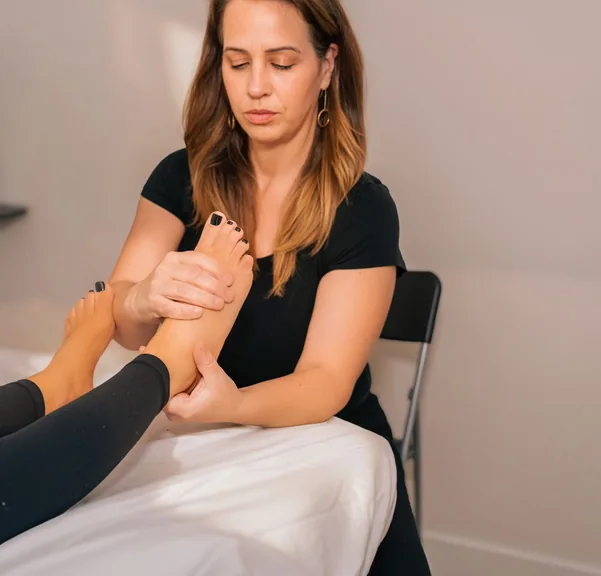
- Massage therapy to release the tight chest, neck, and hip-flexor muscles holding you in the rounded position
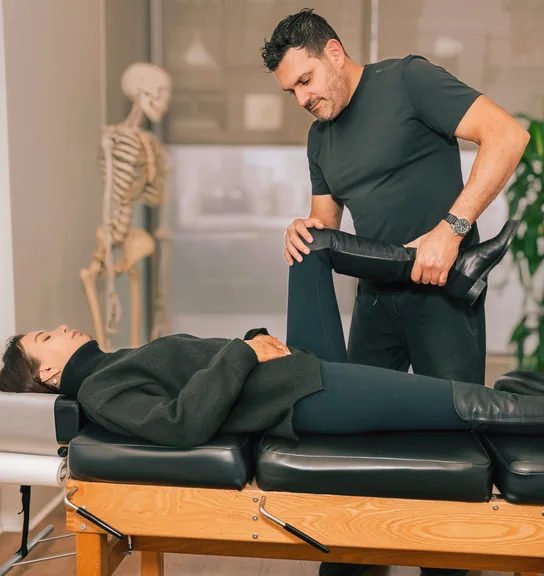
- Chiropractic care to improve joint mobility through the mid-back, where most of the stiffness sits
- Acupuncture to ease the muscle tension and stress-related tightness that compounds the problem
Small changes in your daily setup matter just as much. Screen at eye level, keyboard close enough that your elbows stay near your body, feet flat on the floor, a five-minute break every 45 minutes to stand and reset. Trying to “hold” perfect posture all day usually just creates more tension. Good posture is balance: enough strength to support your body, enough mobility to move freely, and enough awareness to break the long-static-positions habit.
How long until posture improves?
You will not fix it overnight, but progress comes faster than most people expect. Most patients notice less tension within two to three weeks of consistent care plus targeted home exercises, better awareness of their own posture within a month, and visible postural change over six to twelve weeks. Long-standing patterns take longer. Consistency matters more than perfection.
When should you see a professional for posture?
If you are dealing with ongoing tightness, recurring neck or back pain, headaches that track with desk work, or a sense that nothing you try is working, get assessed. Sometimes posture issues are linked to specific imbalances or restrictions that need a more targeted approach than a generic set of stretches.
Where to start in Vancouver
We can help you work out what is actually contributing to your posture and put together a plan that fits your body and your daily life. Life Integrative is on Dunbar Street in Vancouver, serving Kerrisdale, Point Grey, Kitsilano, and the rest of the West Side. Chiropractors, physiotherapists, RMTs, and acupuncturists work under one roof so your care is coordinated rather than fragmented. Care is led by Dr Daniel Zybutz, DC, the clinic director, with over twenty years of clinical experience.
Book online or call us on (604) 742-0702.
Related reading
- Headaches and Migraines: How Chiropractic Care Can Help — the most common downstream cost of forward-head posture
- Joint Pain That Keeps Getting Worse: What’s Behind It — how postural load drives compensation through the joints
Sources
- Vladimir Janda’s original “upper-crossed” and “lower-crossed” syndrome descriptions.
- Journal of Physical Therapy Science, randomised trials on exercise-based postural correction.
- HealthLink BC, posture and back pain topics, healthlinkbc.ca.
Transcript
Want to fix your posture? I have got three easy steps that can help you. The biggest issue with posture with most of our patients is that they spend long hours at a desk in this position, where they end up experiencing short, contracted muscles in the front and long, weak muscles in the back. So how do you fix it? Well, what do you want to do with a short, contracted muscle? You want to stretch it, of course. And what do you want to do with a long, weak muscle? You want to strengthen it. Using a variety of techniques, we can help release and improve mobility in your upper back so you get the most out of the exercises to give you the best possible posture and outcome.